
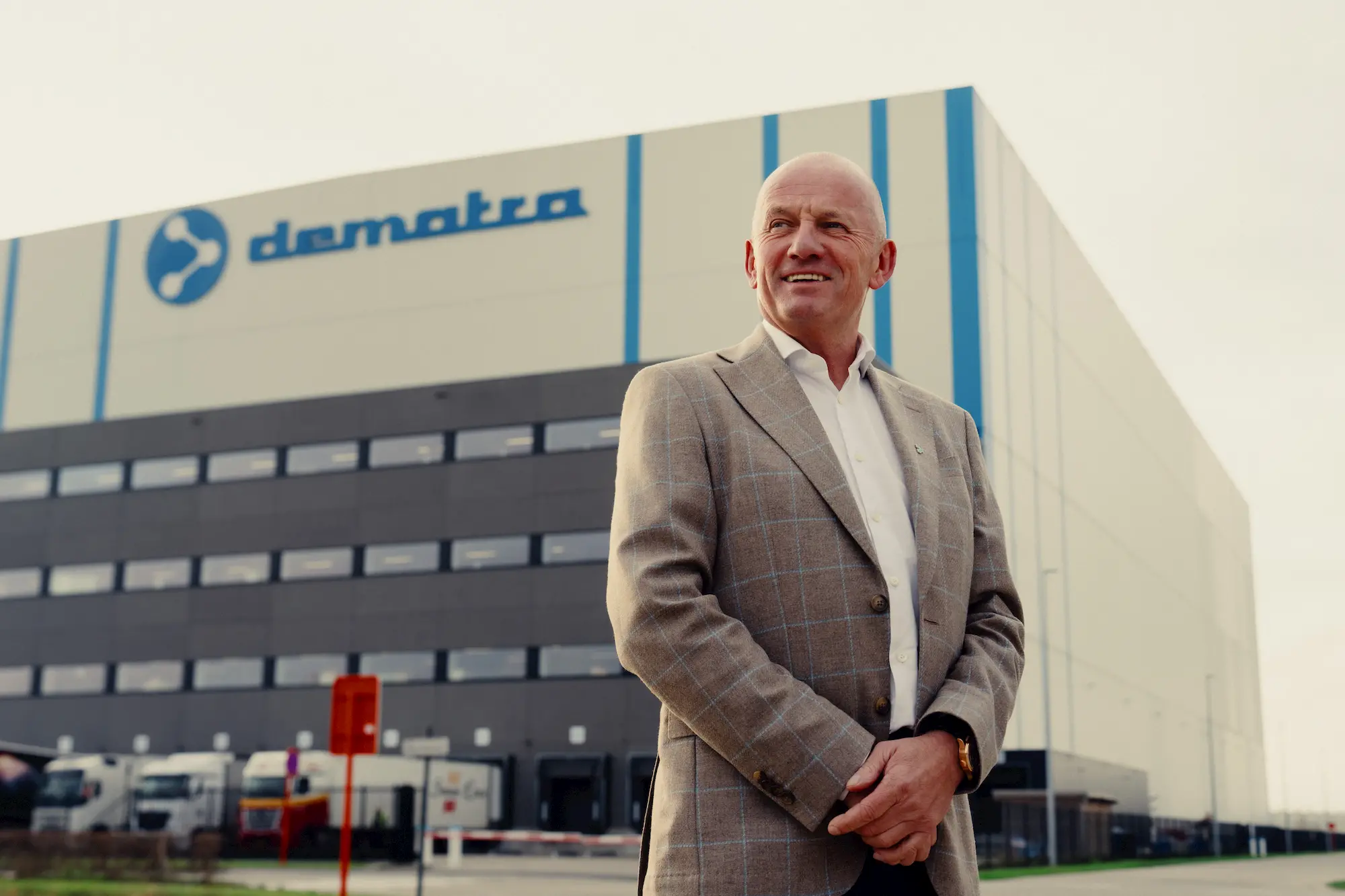
50 years of Dematra: a reason to celebrate, look back, and look ahead. Who better than Geert De Jaeger to do so? For 47 years, he has been helping to build a family legacy that began with his father Marcel and a single delivery van, and has grown into a leading player in logistics and warehousing. “I’m not someone who looks back, but rather looks ahead,” Geert says as he welcomes us into his office. “But I do think my father would be proud of what we’ve made of it.”
50 Years of Dematra, Geert. Congratulations.
What does this anniversary mean to you?
“I’m incredibly proud. It also amazes me how quickly those 50 years have flown by—and that I’ve been helping to drive this business forward for 47 of them myself. We’ve grown significantly, both literally and figuratively. Yet running a business today isn’t all that different from the past: it’s constantly hard work. Today, the world runs 24/7, especially in logistics—you have to keep up with that reality.”
What was your situation like when you started at Dematra?
“Back then, I was just a driver, hauling all sorts of stuff around all day” (laughs). I never would have dreamed we’d get this far. We never really planned things out for the long term. We just took it day by day, did our jobs, and tried to keep the company afloat. That went for both me and my brother, who was in the business with me.”
Could you briefly describe those early days again?
“My father was a farmer. In 1962, when I was born, we ended up in Deinze after our land was expropriated. He had eight children and needed a way to transport them. With the delivery van he bought for that purpose, he also started making deliveries. When that proved successful, the van turned into a small business. That was our humble beginning in transportation and logistics.”
Are there any lessons from that time that you still apply today?
“You only get ahead in life if you work hard. My parents really drilled that into me. My father had a strong work ethic; all the kids had to work during the holidays. That might sound like coercion, but for us it was the most normal thing in the world. I worked in greenhouses, picked tomatoes, cut cauliflower, and made pancakes in tearooms—it was just something you had to do. Luckily, I actually enjoyed doing it all.”
“My father passed away when I was 16. There were eight of us at home. From the time I turned 18 until my wedding at age 26, my brother and I worked for the family business so that my mother, my sisters, and we ourselves could build a life. I started out as a driver, then shifted my focus to the business side. Getting in the car, driving around, finding customers, and promoting your business or service: that suited me well, and it’s always fascinated me.”
Did you miss any specific skills?
“Absolutely. I don’t have a knack for languages like my brother Stefaan or my children do. That held me back as Dematra was growing. Northern France and Wallonia were always close by, but they felt like a barrier because I couldn’t express myself in French. Now things are different: we have some excellent clients in Wallonia.”
You only get ahead in life by working really hard: that’s what we were taught at home.
How did you initially grow the business?
“My brother and I each had our own strengths, and our roles were clearly defined. He handled the finances and human resources, while I took care of sales and planning. We found good customers and set prices that allowed us to make a profit. We didn’t want to be the biggest, but we did want to be wealthy and strong enough to grow our business at our own pace. We succeeded in doing that.”
Did everything always go smoothly?
“Absolutely not. We saw a lot of black snow back then. Dealing with the banks wasn’t always easy either: when the sun is shining, they give you an umbrella, but as soon as it starts to drizzle, they’re gone. You need them, of course, but you learn from experience to fend for yourself as a company, to be as independent as possible. The company is our baby, after all.”
How do you plan to help that "child" grow even further?
“We have a solid foundation of buildings, trucks, and so on. But your people need to be on board with the vision, too. Even if you start at 6 a.m. and finish at 7 p.m. like I do, you can’t do it all yourself. Learning to delegate is one thing. You need strong people, not yes-men. Ideally, people who are just as enthusiastic about the company as you are.”
You need strong people, not yes-men.
“That’s not easy. People join a company of a certain size where there has long been a lot of micromanagement and a weak organizational structure. We’re now countering that by placing top talent in key positions—people who take responsibility and have ambition and vision. You have to constantly steer a company in the right direction and invest in good people.”

The fully automated warehouse, with which Dematra is shaping the future of the industry—was that also a matter of “constantly making adjustments”?
“Absolutely. I firmly believe that automation is the future, that this is the direction logistics and warehousing are heading in. It was a calculated risk, but one backed by a strong gut feeling.”
And apparently, it’s not the first one.
“That’s right. We’ve been through relocations and takeovers, but one of the biggest milestones was the purchase of this first building here, about which my brother said, ‘This is crazy; if anything goes wrong, we’re done for.’ But I went with my gut, and I knew that this location right off the highway was fantastic. It turned out to be the right move.”
Was the new warehouse just as much of a risk?
“Actually, yes. But one-third of the space was already contractually reserved at that time. Originally, construction wasn’t supposed to begin until two-thirds of the space was filled. Given the length of the construction process, we decided to take the plunge anyway, and we actively sought out the right tenants for this type of building throughout the construction process.”
Did you know from the very beginning that that building was meant to serve as a blueprint for the future?
“Yes. It never even occurred to me to turn it into a ‘traditional’ warehouse. When the folks at Clarebout told me about the possibilities offered by Stow and Movu Robotics’ racking and shuttle technology, it was clear that this was the future for Dematra. It was—and is—a 46-meter-high feat of engineering, with space for 80,000 pallets.”
Our warehouse serves as a test case for advanced automation. That is why partners often visit us for benchmarking tours.
Building upward was a necessity.
“That’s right. It’s not just efficient and sustainable—we had no other choice, because there’s no more industrial land available here. We’ve made the most of the last bit of land for this site.”
The warehouse attracted the attention of multinational companies.
“They’re very interested in this type of building with a small footprint. The fact that we can store such a large number of pallets with so many movements every day is unprecedented. We were the first in the world to achieve that level of performance—or that volume. It has resulted in new, major clients. It’s certainly ideal for FMCG (fast-moving consumer goods).”
How does the building reflect the direction the industry is heading in?
“It’s a test case for advanced automation. That’s why our partners regularly stop by for reference visits. IT has been a huge step forward in this sector. I sometimes say, ‘Warehousing and logistics—that’s a concrete building with a lot of IT.’ I don’t mean to downplay everything else that goes into it, but the logistics player of the future is the one who gets the software, hardware, and people to work together in the best possible way.”
“Sustainability has also become an integral part of warehousing. This warehouse is an excellent example of that. Automation makes processes more efficient, which reduces emissions. Solar panels on the roof generate the electricity needed to power the shuttles. And we’re also working to reduce our emissions on the road, for example by using electric trucks. That trend will continue in the coming years.”
Do self-driving trucks have a place in the future you envision?
“Maybe so, but in Belgium it still seems too difficult to me at this point. Traffic density is too high, and our traffic patterns are too complex. But simply driving electric vehicles is already a huge step forward: I’m 100% behind that, and it’s perfect for short distances. Of course, our long-term goal is to phase out polluting trucks.”
How do you view developments in AI for logistics?
“We are actively exploring these possibilities. Cédric (De Jaeger) is working on a new AI-powered scheduling tool. It will help us improve our scheduling in the future, optimize our truck load factors, optimize routes, and so on.”

In your opinion, what are the biggest challenges facing the industry?
“The driver shortage remains an ongoing problem. There are still issues surrounding electrification: we’re actively testing electric trucks, but our grid needs to be able to handle it. When it comes to renewable energy and permits, things always move very slowly in our country.”
“We often talk about buildings, the fleet, and technology. But the biggest issue is road transport. What are we going to do about all those trucks, about all that traffic? We have some of the busiest roads in Europe.”
How do we solve that problem?
“That’s up to the policymakers, to the government. Look at the Kennedy Tunnel; look at Brussels and Antwerp—they’re getting more and more congested every day. I get the feeling that other European countries are already further along in finding solutions to the traffic jam problem. The growth in traffic is unstoppable. But trucks stuck in traffic jams are, of course, costing us a fortune.”
Are there any quick wins?
“You can start by reducing the number of accidents, for example by completely banning cell phone use while driving. It’s really become a major problem in recent years, and our drivers have noticed it too. You can’t just make a ten-ton truck stop on a dime.”
What is Dematra doing to address traffic congestion on our road network?
“In the future, we’ll be focusing heavily on logistics hubs for night shuttles, such as the one in Genk. That way, we can avoid the daytime rush. We may even add a third hub soon.”
Consolidation remains a key priority for Dematra. It’s a case of eat or be eaten.
What's the first thing you want to accomplish in the new year?
“There are plans for an ambitious project in the Netherlands—similar to our fully automated warehouse here, but even larger and even more automated. I certainly hope it gets off the ground.”
Are there any other things we’d like to wish Dematra for 2026?
“That we continue to see strong growth, that our numbers remain solid, and that customers keep coming to us.”
How do you see Dematra evolving in the coming years?
“In addition to the project in the Netherlands, consolidation remains a key focus. In this sector, it’s a case of ‘eat or be eaten’—acquiring companies that can offer us added value remains crucial. It would be even better if we could form strong partnerships with similar players, but experience has taught us that it’s better to acquire than to partner.”
“Of course, we hope to attract other multinationals as well. It really gives us a boost when companies like that come to us. Just recently, I received a compliment from one of our largest multinational clients: ‘Dematra offers a very high level of service, even higher than giants like DHL or Kuehne + Nagel.’ A compliment like that from a client is still what gives me the most pleasure.”
You are truly grateful to your customers.
“Yes. I’m proud of my company and my team, but we can only succeed if we have customers. And you have to do everything you can to keep them. Not just the big ones, but the small ones too. I don’t make any distinctions: every customer pays and receives good service. We have to live up to that every day.”
Do you ever think about Dematra after Geert De Jaeger?
“It has to be that way. The company needs to be able to survive on its own, independent of me. Running a business takes a lot out of a person—I’ve had to give up a lot, but that’s the price you pay. On the other hand, we’ve built something we can be proud of.”
“And as for succession planning—I believe we’re handling it the right way.
“We’re building a strong team that can steer this company into the future. And until then, I’ll just keep working as hard as I always have.”
We are building a strong team that can lead this company into the future.
■


