
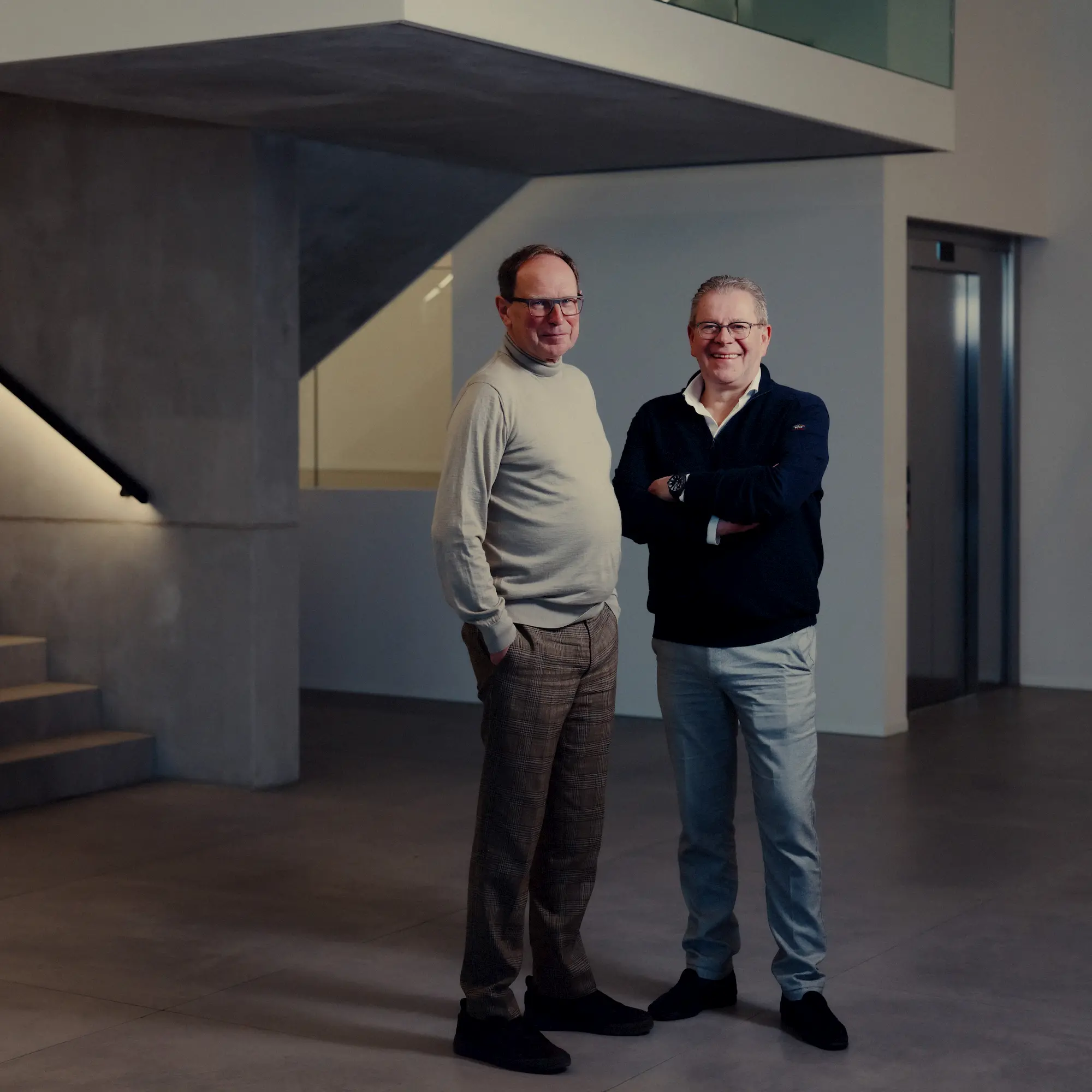
There’s a festive atmosphere at stow in Spiere-Helkijn. Today, the “Rack Stars”—employees celebrating long service anniversaries—are being honored: people who have helped shape the company for 10, 20, 30 years, or longer. The company has grown into a highly profitable player, but it is above all the focus on an additional business segment that is providing the winning combination today: that of robotics and automation, known as Movu Robotics.
Although Movu is a separate entity with its own CEO, the two companies are now inseparable. Jos De Vuyst: “Stow Group is known for its traditional racking systems. But we believe the warehouse of the future will be highly automated—which is why we’re repositioning ourselves as a supplier capable of delivering a fully automated pallet warehouse with Movu shuttles, offering up to 80,000 pallet spaces and reaching heights of dozens of meters.”
That is exactly what stow has delivered at Dematra. The project has become the benchmark for the future of warehousing. Philip Mylle: “We strongly believe in our system of racks and shuttles, but it still took a tremendous amount of courage and vision on the part of Geert (CEO of Dematra) to fully commit to this. Especially on such a large scale. With his multi-million-dollar investment, he is fully committed to growth, efficiency, and sustainability.”
Philip: “A high-bay system like this is extremely energy-efficient: you replace 15-ton cranes with 300-kilogram shuttles. That drastically reduces your energy consumption. The elevated system also provides 40% higher storage density, reduces your footprint, and is easy to expand. At Dematra, the shuttles are powered by solar panels on the roof, among other sources. This allows your company to build an extremely sustainable, carbon-neutral operation.”
A high-rise building like the one at Dematra drastically reduces your energy consumption.
Although Dematra’s fully automated warehouse is already a glimpse of the future in the present, Jos and Philip are already working on the next major innovations. Jos: “AI will make our shuttles even smarter, for example, to detect poor-quality pallets before they are stacked meters high and cause system failures. Another example is the evolution of preventive maintenance: AI will analyze data from all our shuttles to predict when maintenance is needed. This way, you avoid downtime.”

Philip: “AMRs (Autonomous Mobile Robots) will also shape the future of warehouses: we expect them to eventually replace both forklifts and conveyors. However, further software development is still needed in the industry today to ensure the required speed and performance.”
Thanks to AI, our shuttles will become even smarter in the future.
For Jos and Philip, there’s no doubt about it: extensive automation is inevitable. Jos: “The driving forces behind this are, first and foremost, labor shortages. Inflation and wage increases are also making manual labor more expensive. On top of that, companies are finding it difficult to find space to expand further. That means you have to build taller and more compactly, and a solution like ours can help.”

He qualifies this by noting that people are gradually fading into the background in the logistics sector and that we are moving toward “dark warehouses.” “Is it a bad thing to outsource repetitive jobs that don’t satisfy people to a machine? I don’t think so. Besides, we’ve hired hundreds of people at Movu in recent years. The job profiles are changing, of course, but we’re a job creator, not a job killer.”
Automation doesn't have to be harmful to people: we create jobs, we don't destroy them.
With an annual budget of 20 million euros for new developments, stow aims to help shape the future of warehousing and logistics. At the same time, the company is making significant inroads into other growth markets, such as the United States.
Jos: “We’re already the market leader in Europe, but there’s still a lot of potential in the U.S. We’ve built a factory in Georgia so we can serve American customers directly.” That healthy ambition is also evident in stow’s financial goals. Philip:
“Together, stow and Movu generate about 1 billion euros in revenue; we want to turn that into 2 billion over the next 5 years. Barring any major macroeconomic factors that might affect or slow us down, we should be able to achieve that.”
■


